

The first UTMB took place in 2003. It wasn’t yet the HOKA UTMB Mont-Blanc we know today, now the most prestigious trail event on the planet. On August 29, 2003, Nepal’s Dawa Dachhiri Sherpa won the 150 km race with more than two hours on second place. Two legends were born.
Dawa Dachhiri Sherpa and the UTMB: it’s a great story. The Chamonix race gave him a profile that helped him build a few dreams, literally and figuratively. When he was 9, the Nepalese runner promised himself he would build a home for the elderly in his native village of Taksindu, at 2,900 meters in the mountains around Everest, in the Himalayas on the Nepal-China border. His UTMB success opened doors in Europe, opportunities he made the most of, and he eventually built that home, which opened in 2019. Anyone who’s met Dawa Dachhiri will tell you: he’s generous and genuinely others-first. Now based in France, he no longer races the really long stuff, but he still runs and keeps a close eye on what his fellow Nepalese are going through. The Dawa Sherpa Parrains et Marraines pour le Népal association, launched back in 2007 and run with his wife Annie, is still active, working for better schooling for the children in his village and improved access to healthcare.
 © Dawa Dachhiri Sherpa
Dawa Dachhiri Sherpa’s success was undoubtedly forged partly in the childhood he lived. One of nine siblings, born to farming herders, he followed monastic training from age 6 to 15, where he learned meditation and martial arts among other things. He returned to look after his family when his father passed away. It was while working with his older brother as a cook on a trek in the Himalayas that Dawa Dachhiri Sherpa first came into contact with the world of trail running. He eventually entered a stage race in Nepal organized by a Swiss, won by his brother, also a runner. Dawa Dachhiri stood out with two stage wins… and met his future wife, Annie, who was racing too. In 1995, he made his way to Europe, started racking up trail races, and built a name for himself. He’d confirm it in the years that followed. He won UTMB 2003 in 20:05:55, more than two hours ahead of second. The weather that day was brutal; the Nepalese runner let his mindset and tough legs, shaped on Himalayan terrain, do the talking.
That UTMB 2003 win was followed by plenty of major victories: Grand Trail des Templiers in 2005, 6000D in 2007 and 2009, and the TDS in 2012. All told, Dawa Dachhiri Sherpa has won more than 100 races, including the prestigious Annapurna Mandala Trail stage race (2002) on home soil. Late August 2012 says a lot about the Nepalese runner’s toughness and career: three days after winning the Grand Raid des Pyrénées, he went on to win the TDS. Ridiculous durability. Dawa Dachhiri Sherpa also has a unique claim: he competed in three editions of the Olympic Games (2006 in Turin, 2010 in Vancouver, and 2014 in Sochi), as his country’s sole representative, in… cross-country skiing. The Taksindu native had never put on skis before the Nepalese Olympic committee asked him to take part in the 2006 Games, on the basis that he could train in the Swiss mountains. Dawa Dachhiri took it seriously, trained hard, and finished all three events.
 © Dawa Dachhiri Sherpa
Just a few days before the global event HOKA UTMB Mont Blanc 2026, the Nepalese sporting legend kindly agreed to revisit his memories of 2003, while also talking about what he’s working on now.
Dawa Dachhiri, what memories do you keep from that 2003 UTMB win?
A huge one, obviously. So many images come back when I think about it. I’d never raced a distance that long at the time, so I just showed up to do the best I could, without targeting anything. The start in Chamonix at 4 a.m., the finish, the aid stations (there were fewer than today), all of it is etched in my memory. Finishing late at night in Chamonix, in the rain, was incredible. It was late, the weather was still awful, and about ten kids from Chamonix ran with me from the edge of the forest to the finish. It was beautiful. Talking with all the volunteers, feeling their support, those are great memories too.
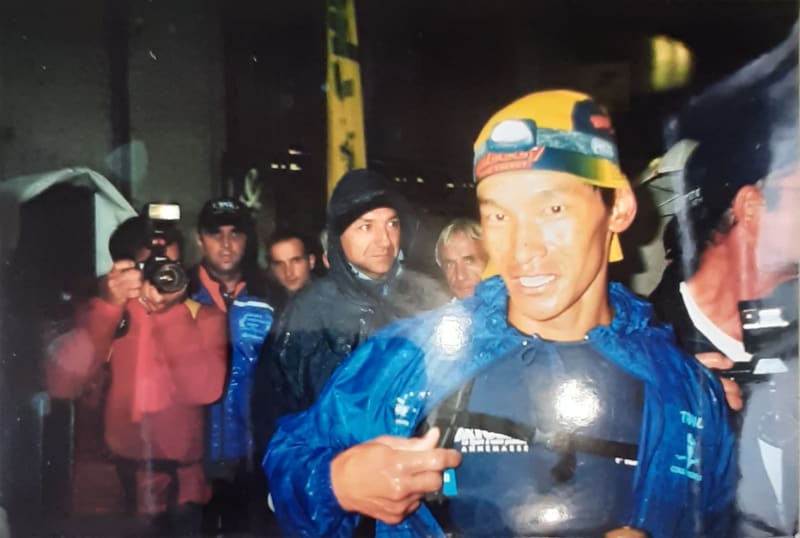 © Dawa Dachhiri Sherpa
That year, UTMB was celebrating its very first edition, driven by Catherine and Michel Poletti…
Yes, there were around 700 of us at the start in Chamonix; 70 at the finish; in cold, steady drizzle. Nothing like today’s event, with so many runners coming together. I’m happy the sport has grown like this, even if I’m a bit wary of the trend effect. You have to keep in mind the pleasure of running on trails, not necessarily performance. Still, it’s a very good thing that so many people have taken up running. It’s better than going to the pub!
Would you say UTMB is your best trail win?
One of my best wins, for sure. It’s a victory that later gave me a lot of opportunities in Europe, so it’s clearly important in my story. Winning the Grand Trail des Templiers in 2005 was incredible too. Whatever the distance, I was lucky to race lots of great events, with a family vibe and perfect race conditions. Even in the races where I DNF’d, I have good memories. Everything is experience. A race goes the way it’s meant to go; I accept it as it is. I never raced to win.
In 2008 you finished second behind the giant Kilian Jornet, then 21 years old…
He could be my son! There wasn’t any rivalry between him and me, even if we battled well that day (editor’s note: Dawa Dachhiri Sherpa finished second in 21:56:52, an hour behind the Spanish runner). I was working as a bricklayer on job sites during the week, five days out of seven, with long hours. We absolutely didn’t live the same reality. It was normal to finish behind him.
 © Dawa Dachhiri Sherpa
Many people who met you during your career talk about your ability to listen to your body and respect it…
For me, a long-distance race is an experience, a study of my body, my nutrition… The education I got at the temple gave me that ability to listen to my body and my feelings. Does this food work better than another? Do I digest it better? I try to give my best without going into the red. If it goes well, great; if not, too bad. I’ve always respected my body and pain signals. From 2013 to 2016, I had knee problems that really held me back. After a year of rehab, I saw a doctor who told me I could start running again. But I felt something else, telling me to wait longer. Physically, I didn’t feel capable of doing such long distances without hurting myself. I waited another two years before running again, but now I stick to shorter distances, distances for normal people (laughs).
Your mindset gets praised too…
When I race, I never think about winning. I run for myself. I’ve always tried to fight desire and jealousy, which create negativity. That weighs on the body. When you’re focused on yourself and your sensations, you’re more present with every step and you make the right movements. When you’re focused on an opponent, you stop doing the right things. When you hit a rough patch, take a deep breath, look far ahead, and you’re back. Positivity brings a lot of strength. For example, when the weather is bad, when it’s a tough moment, receiving or giving a smile takes the edge off the difficulties and the pain…
 © Dawa Dachhiri Sherpa
You don’t miss long-distance racing that much?
(confident) Not at all. I’m totally at ease with what life gives me today. There’s so much to do. After this interview I’m going to work in our garden, there’s work to do (smile). I’m going to pick tomatoes, pull a few weeds… It matters to me; it brings me back to the life I knew in Nepal. It’s very relaxing. I stopped racing long distances in 2012, after my win at the TDS. Since then I’ve mostly done races from 15 to 50 km, where I just enjoy myself. I wouldn’t say no to a 70–80 km race if I have a window that lets me prepare for it properly.
Outside of your work, part of your time is devoted to your community in Nepal…
I try to go back to Nepal at least once a year. When there are building projects that need attention, I’ll spend time there as well. I created a small association that allows us to do things collectively and carry a bit more weight. Alone, you can’t do anything. Thanks to many people, over the years we’ve been able to build a boarding school for young people and a welcome center for the elderly in our area. I want to use this interview to thank everyone who has helped us, and those who joined the association. It’s thanks to all these people that we’ve achieved great things, and we hope to do more. Around a hundred children study at our center. We’re very happy because it’s working well; the project is alive. Every time we can improve the children’s lives, we do it, with the means we have.
//// UPDATE September 3, 2026
On August 26, a flash flood triggered by the collapse of a mountainside and a glacier devastated Nepal’s Trishuli valley, causing many casualties (1,259 dead and more than 5,000 missing as of September 3) and leaving many families in distress.
Dawa Dachhiri Sherpa and his association Parrains et Marraines pour le Népal have launched a fundraiser to help people on the ground. Donate here: https://www.dawasherpa-asso.org/urgence-nepal/.
More articles

Vincent Bouillard and Baptiste Chassagne: the UTMB 2026 favorites on intersecting paths
Vincent Bouillard and Baptiste Chassagne return to Chamonix as UTMB 2026 favorites after big 100-mile wins at Western States and the Diag’.
Thu, August 27, 2026

Aurélien Sanchez, the only French runner on the Barkley winners list
Barkley winner Aurélien Sanchez looks back on his 2023 finish and the challenges of the world’s toughest trail race.
Mon, August 3, 2026