
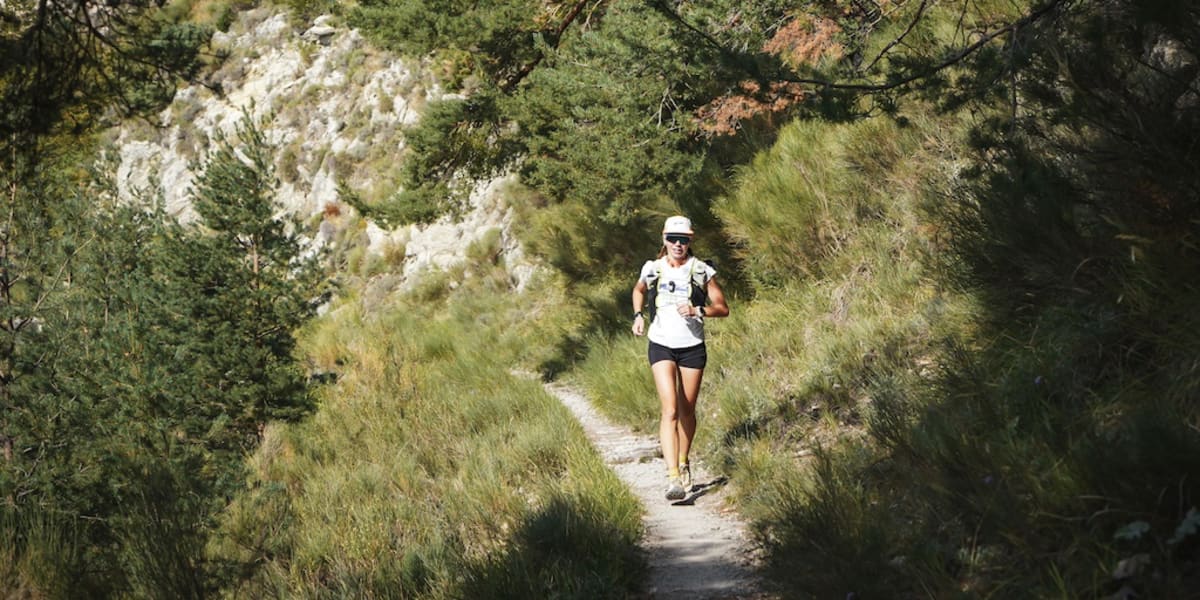
Julie Garnier takes on the ultra with humility
Julie Garnier, 28, finished fifth at last September’s Nice Côte d’Azur by UTMB in the 100 km race, her first ultra-trail event. Forged on the track and road, the content creator now appears fully committed to trail running, with the same simplicity and humility that have defined her career. Meet a successful all-rounder who champions a measured, progressive approach to running.
A need to stop chasing the clock. That is how Julie Garnier, who came up through track and cross country before moving into road racing, now explains her attraction to trail running. A sub-three-hour marathoner (2:56:49 in London) with a 36:57 10K best, the 28-year-old, who has been running since she was 13, is now looking towards wilder horizons on the trails.
In trail running, I no longer look at my pace. There is no longer that pressure to hold a particular tempo over a particular distance, as you do in a marathon or a 10K. You just run for the pleasure of it, to enjoy the scenery.
With a deep running background built from an early age, and now a successful content creator too, she completed her first 100K last September at the Nice Côte d’Azur By UTMB (113 km and 5,400 m of elevation gain), finishing fifth.
It is a career direction that meets a personal need, as she explains. « In trail running, I no longer look at my pace. There is no longer that pressure to hold a particular tempo over a particular distance, as you do in a marathon or a 10K. You just run for the pleasure of it, to enjoy the scenery. There are other challenges, of course, such as managing all the uncertainties linked to the terrain, nutrition and weather… These are things you cannot control in advance, which takes away some of the pressure before race day.
 © JG
© JG © JG
© JG © JG
© JGA gradual approach and a wise choice of distances
For Julie, adapting to this new playground followed the approach she advocates in every discipline she takes on, and shares with her thousands of followers: progress gradually and choose distances wisely. Despite nearly 15 years of running experience and a rock-solid aerobic base, Julie started with shorter trail races of around 20 km before moving up to 40- and 50 km events. « Before I got serious about trail running, I was already doing a lot of running in nature, so I was used to the terrain. I did have to adapt my nutrition, though, compared with what I knew from road running. In trail running, you have to learn to eat much more during the effort and build that routine into your training ».
Certain hill sessions and shorter trail distances can recreate some of the sensations you get during track intervals.
Training-wise, Julie also had to adapt her programme to her new passion. « It’s been more than a year since I last set foot on the track, she says with a smile. My training is a little different. I do more uphill and downhill work, and I fit in a few short mountain camps so I can train in an environment similar to what I’ll encounter in competition », explains the runner, who now lives near Marseille.

For now, she does not miss the track sessions. She has found other ways to push herself into the red. « I can assure you that certain hill sessions and shorter trail distances can recreate the sensations of track intervals », says the runner, who still slots threshold and VO2 max sessions into her schedule. The basics do not disappear.
A controlled approach that carried her into the ultra
As the results followed (wins at the Trail de Haute-Provence 30K 2026 and the UT4M 40 Chartreuse 2026, third at the Balcons du Ventoux 2026, seventh at the SaintExpress 2025, plus two top-10 finishes at the MCC in 2025 and 2026), Julie naturally raised the bar to ultra-trail, with immediate results, including that fifth place in Nice in her first 100-kilometre race.
 © 6000D
She prepared for that target by taking on three races at the 6000D event in the middle of summer. The 6D Crêtes (21 km and 1,300 m of elevation gain), which she finished eighth, opened the sequence, followed the next day by the 6D Lacs (25 km and 1,500 m of elevation gain), where she placed fifth. On day three, she completed the 6D Marathon (44 km and 2,700 m of elevation gain) in 15th place. It was an ideally timed block of three races in her preparation, before she confirmed her form in Nice with fifth place in her first ultra of more than 100 km.
A successful first 100K
« I’m obviously delighted with the result because everything went really well, despite the highs and lows that are part and parcel of ultra running. Nothing that stopped me from reaching the finish, though. I think the experience I built up over shorter distances of 40, 50 and 70 km helped me develop the mental strength I needed for this first 100K. Last year, I went through hell at the Trail du Petit Saint Bernard, a 70 km race with 4,000 m of elevation gain. It remains one of the worst races of my life. I hit a huge wall and suffered terribly, including through sections in the snow. It was extremely difficult, but I finished fifth. When I arrived at that 100K in Nice, I remembered the experience and told myself that things could not get any worse, which helped me put it into perspective ».

Progress slowed by RED-S
That fifth place in the international-level Nice race will not make her lose sight of reality. Although the 100-mile distance is naturally a long-term goal, she will remain true to her philosophy, building her career one step at a time. « I want to take my time before tackling the 100 miles. I waited until I had mastered the maratrail distances before moving up to 100K, and I think I’ll follow the same pattern before taking on 100 miles: repeat the experience over 80, 90, 100 and 110 km before making the big leap to 100 miles ».

Julie knows the risks of trying to move too fast and placing too much stress on her body, having already endured long periods on the sidelines with injuries. Like many female trail runners, she has also experienced RED-S, the syndrome of relative energy deficiency in sport, which sidelined her for a while. « It taught me to manage my nutrition better, and above all to eat more. I did not have an eating disorder, and I was not trying to lose weight. The energy deficit really developed unconsciously, affecting me physically, with shin splints and pain that led to several months off », the young runner explains. « Since changing my diet, I have never been injured again, although I’m still keeping my fingers crossed ».

Reminding her community to take its time
This is the message of restraint she wants to share with her social media followers, rather than simply glorifying her achievements: « I think it’s important to take your time and adopt a gradual approach to your training, Julie insists. Today, we see beginners lining up for an ultra after just a few months of running. It’s a booming format, but for now we do not have much perspective on the physical, physiological and psychological consequences of taking on such distances. We are already seeing a lot of people getting injured, and I don’t think that will improve over the coming years ». Julie uses her social platforms to share that message with her community. Simply and humbly, for the benefit of as many people as possible.