
Elazzaoui wins the Muju Trail final and a third straight Golden Trail World Series crown
 © © GTWS / Koastal Forest
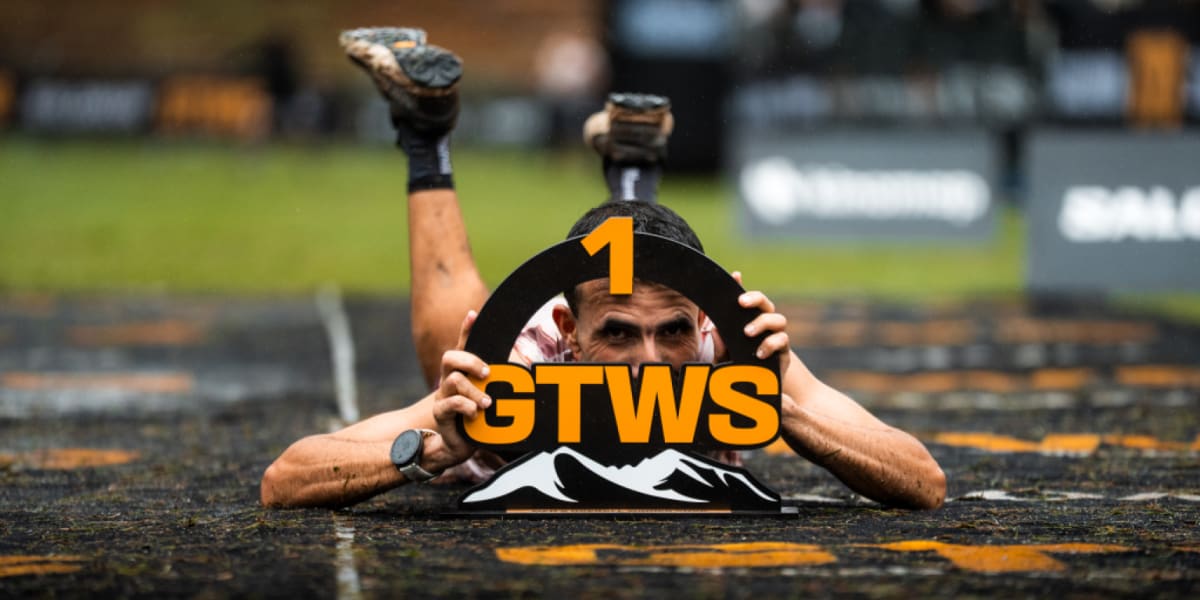
Morocco's Elhousine Elazzaoui (NNormal) delivered a masterclass at the Muju Trail in South Korea. His fourth win of the 2026 Golden Trail World Series (GTWS) came in the final, and it sealed a third consecutive overall title, making him the most decorated athlete in the circuit's history. Romania's Madalina Florea (Scott) did the same on the women's side, defending her overall title. Salomon takes the first-ever GTWS team classification.
Moroccan Elhousine Elazzaoui (NNormal) turned in a historic performance in the Golden Trail World Series final, held at the Muju Trail in South Korea. He took his third consecutive series title after a fourth win of the season (following Ledro Sky Trentino, the Salomon Pitz Alpine Glacier and Zegama-Aizkorri), this time on one of the most technical and demanding courses the series has ever offered: 28.65 km and 2,313 m of vertical gain. With this latest crown, he becomes the most decorated athlete in the series' history and confirms, once again, his special bond with this competition.
Kenya's Patrick Kipngeno (Run2gether On Trail) finished second in the race and in the overall standings, while his compatriot Timothy Kibett (Salomon) completed the podium. It was a much tougher day for Kenya's Philemon Kiriago (Run2gether On Trail). The overall leader going into the final could do no better than 11th, lost any chance of keeping top spot and dropped to third in the final standings.
Elazzaoui turns the final around by going on the attack
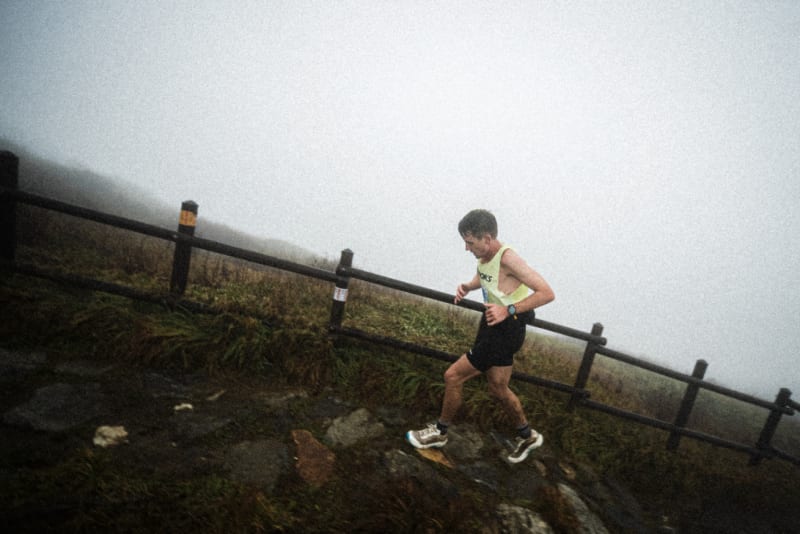
The men's final started in the rain. Despite the difficulty of the course, the opening kilometers were the most runnable of the day, on a wide track leading toward Seolcheonbong before the field hit the most technical sections.
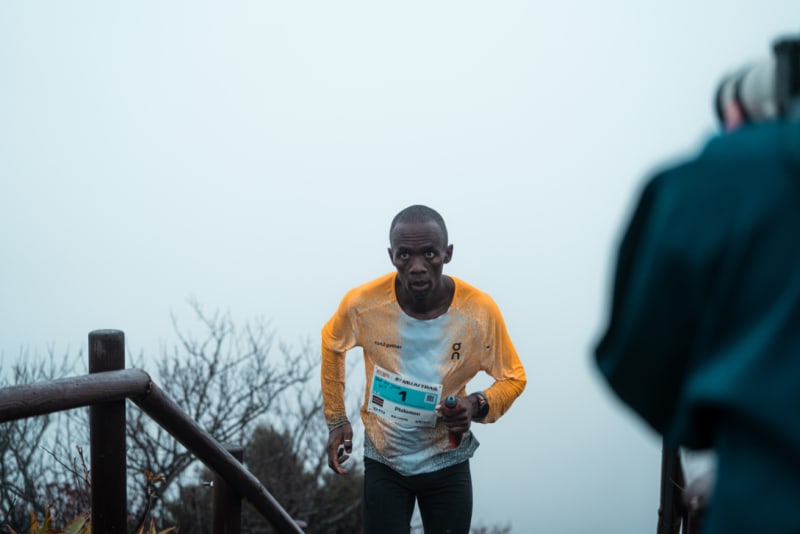
Kiriago, the overall leader, made the first move in the opening meters of the climb, but his solo break was quickly reeled in. A small lead group formed, with all three title contenders in it. Kipngeno, however, didn't look comfortable and briefly stopped, a first sign that the decisive battle wasn't starting the way he'd hoped.
 © © GTWS / Koastal Forest
As the slope steepened, the group stretched out. Mexico's Brayan Rodríguez and American Taylor Stack (Brooks) took over at the front, with Kiriago, Spain's Alain Santamaría (X-Bionic Integrity) and Salomon's three representatives, Switzerland's Joey Hadorn and Kenyans Ezekiel Rutto and Samwel Kiprotich, just seconds behind.
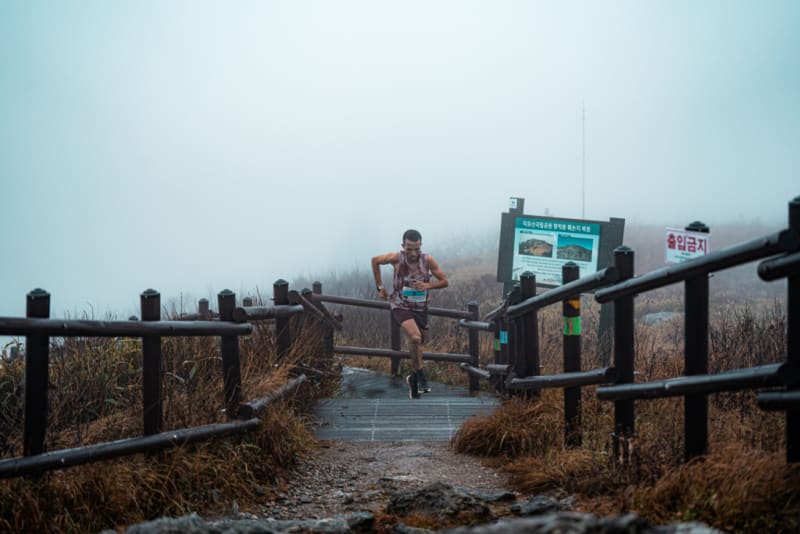
But the race was far from decided. On the section linking Seolcheonbong to Hyangjeokbong, at around 1,600 m and the highest point of the course, another surge blew the group apart. This time it was Elazzaoui who attacked. Knowing that only a win would keep his shot at a third overall title alive, the Moroccan raced far more aggressively than usual and launched a decisive move to go clear.
 © © GTWS / Koastal Forest
By the time he reached Hyangjeokbong, around kilometer 6.5, Elazzaoui already had about a minute on a chase group made up of Stack, Rodríguez, Kibett, Hadorn, Santamaría and Kenya's Michael Selelo Saoli (Run2gether On Trail). Further back, Kiriago and Kipngeno were already more than a minute and a half down. Kipngeno's struggles continued while Kiriago's grip on the overall lead began to slip.
Timed bonus segments that could prove decisive
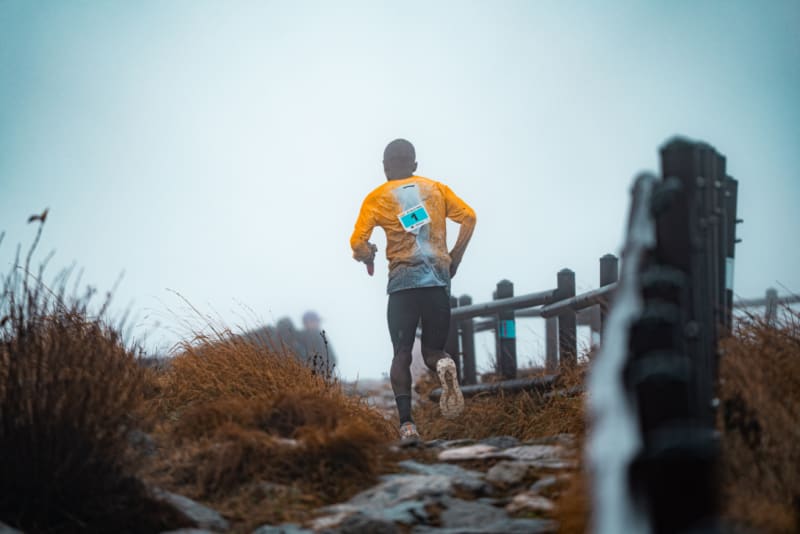
The course then served up ideal terrain for Elazzaoui: a vertiginous descent to the Baengnyeonsa temple, over steps, rocks and rain-soaked leaves. While the Moroccan seemed to glide through these technical passages, his rivals fought to hold their rhythm on a descent that demanded precision, confidence and control.
Santamaría flew down the timed 2.5 km descent, averaging 28%, in 11:54. Elazzaoui was fifth and banked two valuable extra points in the overall standings. A seemingly modest bonus, but one that could be decisive in an extremely tight fight for the title.
The timed segments had done much to keep the overall standings open all the way to Muju. Without the bonus points collected over the season on climbs, descents and sprints, Elazzaoui would have arrived at the final as leader. But Kiriago had banked 106 extra points from those segments against 58 for the Moroccan, which gave him an edge going into the last race.
 © © GTWS / Koastal Forest
 © © GTWS / Koastal Forest
 © © GTWS / Koastal Forest
 © © GTWS / Koastal Forest
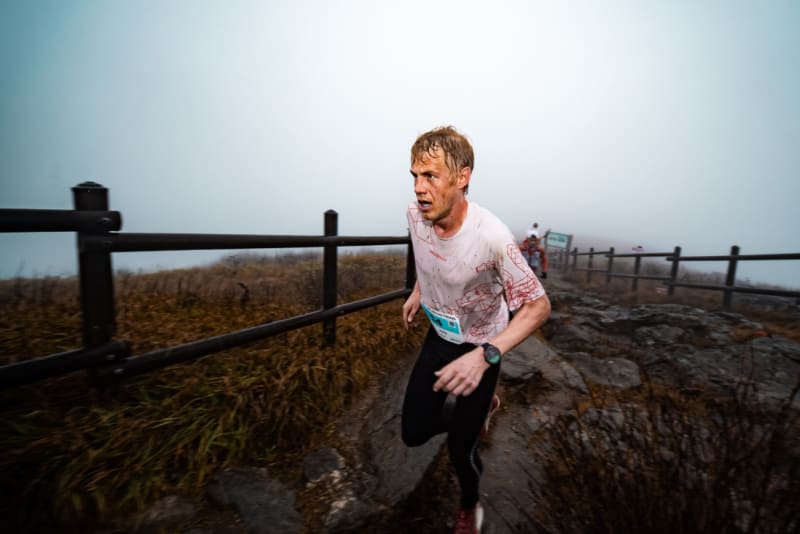
By kilometer 9, the picture had changed completely. Kiriago was in tenth, four minutes off the front, and his hopes of keeping the lead were fading. Elazzaoui, for his part, kept pushing a hard tempo at the front, chasing the win he needed.
On the second climb to Hyangjeokbong, the positions behind the leader shifted again. Elazzaoui firmly controlled the race, with Santamaría and Stack leading the chase. Stack responded to take back second, while Hadorn closed on Santamaría and joined the fight for the podium. At the summit, Elazzaoui had stretched his lead to more than five minutes over his nearest pursuers and more than twelve over Kiriago, now fifteenth.
The sprint segment was also contested on this section: 1.1 km at an average gradient of -7.7%. Czech runner Jan Fiala set the best time in 3:08, ahead of Kiriago. Despite struggling to adapt to the course, the Kenyan showed he still had plenty of speed. His second place on the segment earned him eight extra points, trimming his deficit to Elazzaoui in the overall title race.
Kipngeno's comeback isn't enough…
Once the sprint was over, the race exploded again, this time in the battle for the podium. Fatigue was starting to bite when Patrick Kipngeno burst into the picture. At the foot of the last climb, around kilometer 21, the Kenyan was about two minutes behind Stack, Santamaría and Hadorn. Barely two kilometers later, at the final summit, he had worked his way back up to second.
He wasn't the only one accelerating late. Timothy Kibett also passed Stack and Santamaría before going after Hadorn, turning the final kilometers into a fierce fight for the podium. With one last descent and fewer than five kilometers to go, everything was still possible behind Elazzaoui, who had controlled the race since the first climb.
 © © GTWS / Koastal Forest
The Moroccan never faltered. He crossed the line in 2:49:14, one of the best performances of his career, delivered when the stakes were highest. Kipngeno finished just 43 seconds later, capping a spectacular comeback and a season that kept getting stronger, with two wins and another podium in the final Asian trilogy. Kibett completed the podium, about a minute and a half behind the winner.
In the season standings, Elazzaoui jumped from third to first to take the overall title with 1,130 points, just two more than Kipngeno (1,128), who holds on to second. For Kiriago, the final brought a dramatic reversal: leader before the race, he ends up third overall with 1,075 points.
Today I gave everything. I knew I was taking risks, but I told myself: “If something happens, so be it.” I even wrote “To be or not to be” on my hands to remind myself that today was all or nothing. Winning three titles on the Golden Trail World Series is a record. For me, it's truly historic. I'm so happy I struggle to find the words.
The Moroccan is already looking ahead. He's considering a move to longer distances, but he doesn't rule out coming back to add to his record: “I want to come back next year, because it will be the 10th anniversary of the Golden Trail World Series, and that will be very important to me. We'll see if I still have the chance to fight for another big result”
Men's Top 5, final stage
1) Elhousine Elazzaoui (Morocco): 2:49:14
2) Patrick Kipngeno (Kenya): 2:49:58
3) Timothy Kibett (Kenya): 2:50:48
4) Joey Hadorn (Switzerland): 2:52:22
5) Alain Santamaría (Spain): 2:54:00
Men's Top 10, 2026 overall standings
1) Elhousine Elazzaoui (Morocco): 1,130 points
2) Patrick Kipngeno (Kenya): 1,128
3) Philemon Kiriago (Kenya): 1,075
4) Michael Selelo Saoli (Kenya): 968
5) Timothy Kibett (Kenya): 922
6) Nashon Kiplimo (Kenya): 820
7) Bogdan Damian (Romania): 812
8) Ezekiel Rutto (Kenya): 770
9) Alain Santamaría (Spain): 759
10) Joey Hadorn (Switzerland): 743
Women's race: Andrea Kolbeinsdóttir springs a surprise and Madalina Florea defends her title
On the women's side, the Muju Trail revealed a new star. Iceland's Andrea Kolbeinsdóttir (Salomon) took her first win on the international circuit the day before the men's race, on a course made even tougher by the rain.
A few minutes later, Romania's Madalina Florea (Scott) crossed the line in second with one more reason to celebrate: the result secured her overall GTWS title for a second year.
Kolbeinsdóttir: a star is born
The opening kilometers created the first gaps, on the only stretch of the course where athletes could settle into a steady racing rhythm, on a wide track with little elevation change. The women then tackled a demanding six-kilometer climb toward Seolcheonbong.
Kenya's Caroline Kimutai (Salomon) took charge and opened a gap at the front. Madalina Florea followed 24 seconds back as they approached the transition section toward Hyangjeokbong, the course's high point at over 1,600 m.
 © © GTWS / Koastal Forest
Behind them the race stayed wide open, with Romania's Madalina Amariei (Kailas Fuga), Kenya's Ruth Gitonga (Run2gether On Trail), Andrea Kolbeinsdóttir (Salomon) and American Hanna Groeber (Nike ACG) all within two minutes of the lead.
The race turned on the first descent to the Baengnyeonsa temple: 2.5 km at an average gradient of 28%, with steps, wet rocks and a carpet of dead leaves hiding the ground, making an already technical descent even trickier.
Florea caught Kimutai halfway down and took the lead, while her compatriot Amariei closed to within a minute to reach the bottom in second.
But it was Andrea Kolbeinsdóttir who used the descent to launch her attack. The Icelander caught Kimutai before becoming Florea's main rival on the next climb to Hyangjeokbong. On the technical forest trails and uneven rocks, she gradually closed the gap before passing the Romanian near the summit. The two women then started the second descent to the temple together.
 © © GTWS / Koastal Forest
Behind the two leaders, Amariei took third from Kimutai on the descent. Kimutai then fell and was also passed by Mexico's Miriam Morales, ending her hopes of an overall title. Groeber's race also came to an end: the American dropped out with muscle problems, in her first race back after breaking her wrist at the Great Wall of China race.
The Icelander pushed her limits and fell on the descent, but still reached kilometer 17 with a 35-second lead over Florea.
With the other contenders now more than five minutes back, the win would be settled between the two women. But Kolbeinsdóttir's lead quickly evaporated and Florea retook the lead on the transition to the last big climb, toward Chilbong.
A breathless duel for the lead
The two women traded the lead through the first kilometers of this decisive climb: 2.2 km at an average gradient of 25.2%, with sections beyond 40%, huge steps and slippery rocks that sometimes forced athletes to use their arms to make progress.
It was on this climb that Kolbeinsdóttir made her decisive move. The Icelander finally dropped Florea, who was also struggling to keep her footing on the slick terrain, and reached the summit with almost three minutes in hand. That gave her a comfortable margin going into the last descent. The fastest time on the climbing segment went to Switzerland's Theres Leboeuf (Compressport / Lowa), who finished it in just over 32 minutes.
 © © GTWS / Koastal Forest
 © © GTWS / Koastal Forest
Rather than settle for managing her lead, Kolbeinsdóttir kept extending it on the final descent and crossed the line almost six minutes ahead of Florea. The Icelander took her first Golden Trail World Series win in 3:19:56.
Behind her, a beaming Florea crossed the line and celebrated by rolling in the puddles. Her second place brought an even bigger reward: a second consecutive overall title on the Golden Trail World Series.
The fight for the last podium spot was much tighter. Morales and Amariei arrived almost together on the final ramp through the ski resort, but the Mexican held on to third by just 24 seconds.
From Australia to South Korea, Kolbeinsdóttir's road to victory
Andrea Kolbeinsdóttir's path to victory in South Korea began several months earlier, thousands of kilometers away, in Australia.
“It was pretty funny. I was in Melbourne and my coach told me I could enter the Golden Trail National Championships (GTNC) and that I had a chance to win. I won the race and got a Golden Ticket to come here, to South Korea,” she explained.
 © © GTWS / Koastal Forest
Golden Tickets give direct entry to the GTWS final. The scheme is designed to spot the best national talents and rising stars of trail running, giving them the chance to measure themselves against the international elite.
After securing her ticket to Muju, Kolbeinsdóttir had already shown her potential at Ledro Sky Trentino in Italy. She finished fifth there, proving she could hold her own against the best athletes in the world. She also showed her skills on technical terrain by setting the fastest time on the descent segment.
I have to admit that this morning I told myself: “I can win.” I was very positive and I really believed in myself. It's a course that suits me very well. I'm comfortable on technical terrain. Maybe I'll dedicate next year to the Golden Trail World Series.
Florea wraps up a near-perfect season with a second GTWS title
At the end of a season marked by remarkable consistency, Madalina Florea was crowned Golden Trail World Series champion for the second time. The Romanian had a near-perfect 2026 campaign, with wins at the Québec Mega Trail, the Salomon Pitz Alpine Glacier Trail and Sierre-Zinal. In the only two races she didn't win, Ledro Sky Trentino and the Muju Trail final, she finished second.
 © © GTWS / Koastal Forest
The Romanian ends the season with 1,164 points, ahead of Caroline Kimutai, second with 1,016, and Ruth Gitonga, third with 982.
It's the hardest race I've ever run. I couldn't feel my body anymore.
Women's Top 5, final stage
1) Andrea Kolbeinsdóttir (Iceland): 3:19:56
2) Madalina Florea (Romania): 3:25:46
3) Miriam Morales (Mexico): 3:29:12
4) Madalina Amariei (Romania): 3:29:35
5) Barbora Bukovjan (Czech Republic): 3:29:54
Women's Top 10, final overall standings
1) Madalina Florea (Romania): 1,164 points
2) Caroline Kimutai (Kenya): 1,016
3) Ruth Gitonga (Kenya): 982
4) Barbora Bukovjan (Czech Republic): 974
5) Marie Nivet (France): 892
6) Silvia Schwaiger (Slovakia): 765
7) Theres Leboeuf (Switzerland): 764
8) Estel Roig Fortin (Spain): 737
9) Renée Cradinaals (Netherlands): 730
10) Hanna Groeber (USA): 718
In the first edition of the team classification, Salomon finishes the season on top after remarkable consistency all year, and also won the team ranking at Muju. Timothy Kibett's third place and Joey Hadorn's fourth among the men, combined with Andrea Kolbeinsdóttir's win and Barbora Bukovjan's fifth place among the women, let the team close out its season in the best possible way.
With the 2026 season now over, attention is already turning to 2027, with the calendar due to be unveiled soon.