
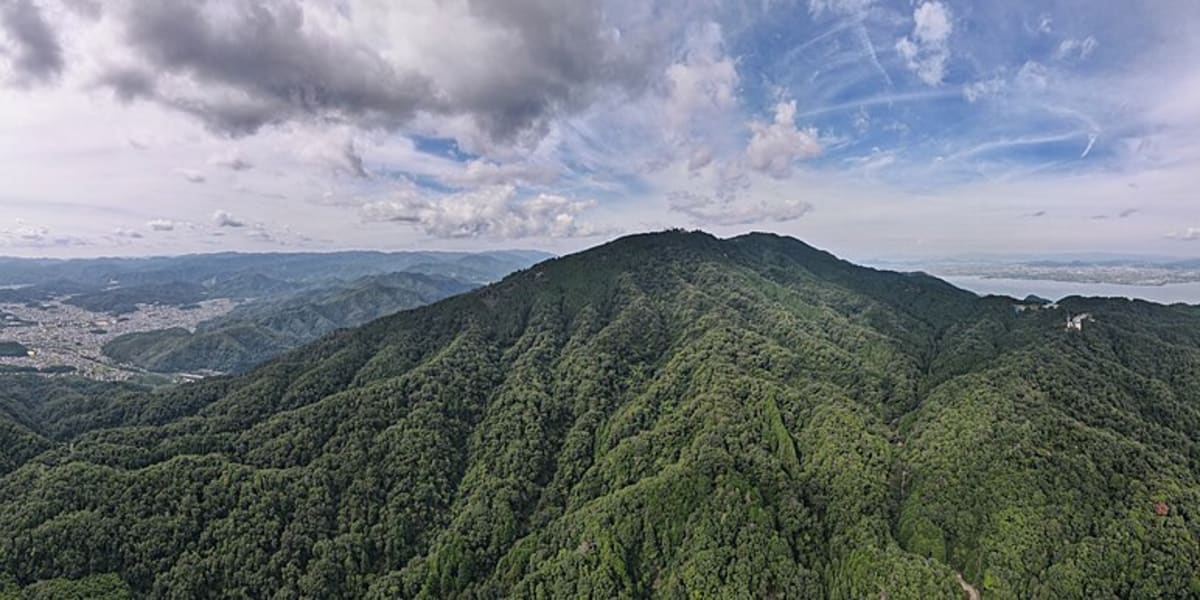
High on Mount Hiei in Japan, Buddhist monks give years of their lives to an ascetic discipline built on walking, prayer and deprivation. Known in the West as the marathon monks' ordeal, the kaihōgyō is a Tendai Buddhist practice that sends them through a punishing 1,000-day course.
A thousand days of walking, daily outings that can run well past a few dozen kilometers, rugged trails, departures in the middle of the night and an iron discipline stretched over seven years: the kaihōgyō has every ingredient of a modern endurance story. Yet the men who go through it aren't out to push physical or athletic limits. Their quest is spiritual. In Japan, they are nicknamed the "marathon monks." The kaihōgyō is a form of asceticism in Tendai Buddhism, the Japanese strand of the religion. The monk, known as a gyōja, follows a sacred route, stopping at temples, shrines, trees, springs and memorial sites to perform ritual gestures and recite prayers. To understand this tradition, you have to start with the history of a mountain.
Mount Hiei, stage of the ordeal
The history of the kaihōgyō is bound up with Mount Hiei, northeast of Kyoto, the former imperial capital. The Enryaku-ji monastery is the main center of Tendai Buddhism in Japan. The school, founded in the early 9th century by Saichō, puts great weight on meditation, the study of texts and ascetic practice. Over the centuries, the mountain gradually became a major place of religious training. In this tradition, physical effort is not an end in itself but a discipline meant to transform the practitioner. Walking is itself a religious act. Between the 12th and 14th centuries, pilgrimages were organized around the three pagodas of Mount Hiei, before spreading to the whole mountain. From the late 16th century, the practice took shape around the circuit that still sits at the heart of the modern kaihōgyō.
In 1571, the Japanese army had the Enryaku-ji complex destroyed to curb the influence of the religious orders. Many documents were lost, but the tradition survived. Over the centuries, the kaihōgyō endured as a demanding practice, handed down through monastic lineages. The monk Sakai Yūsai, born in 1926, became one of the best-known figures of the modern practice, having completed two cycles of a thousand days. In 1995, he met Pope John Paul II. Plenty of accounts detail the lives of those who choose this path. The relationship to suffering and sacrifice is central. And as is often the case in Japan, failure is not an option, or only at the price of ritual suicide, at least in popular tales… In Tendai thought, the monks' prayers are directed at trees, rocks, springs, at the natural world. The ordeal is conceived as a bodhisattva practice, one that seeks the good of all beings. Needless to say, the kaihōgyō offers neither a finish line nor a victory over a rival.
A thousand days, seven years and thousands of kilometers
Let's look at the numbers behind this brutally demanding religious discipline. The best known is the thousand days of walking. In its most exacting form, the ordeal follows a traditional program spread over seven years. The calendar alternates 100-day and 200-day periods, while the daily distance grows as the monk progresses. The difficulty lies in repetition and in staying committed over the long haul. Tradition calls for 100 days of walking in each of the first three years, then 200 days a year in the fourth and fifth. The sixth year brings 100 days on a longer course, before a seventh year that includes another extended phase of walking around Mount Hiei and Kyoto, followed by 100 more days on the mountain circuit. The initial course is generally given as around 30 kilometers a day. In the sixth year, the daily distance approaches 60 kilometers, sometimes more… The cumulative total is considerable. Some estimates in the literature on the marathon monks put it at more than 30,000 kilometers.
 © Wikipedia
Researcher Catherine Ludvik, who has studied Japanese religious history, counted 49 completions of the thousand-day cycle since 1585, the point from which documentation becomes more abundant. As you might guess, the difficulty isn't limited to walking. After roughly seven hundred days, the program calls for a retreat known as the dōiri, during which the monk spends nine days in a temple without eating, drinking or sleeping, reciting texts and mantras throughout. There is, however, a collective side that the image of the solitary monk tends to erase. The monk does much of the practice alone, but it also relies on the support of many people along the various routes, whether devotees, guides or simple companions.
On the stages that cross Kyoto, members of lay confraternities help look after the monk. This support is no small detail: it is a reminder that the ordeal remains tied to a community.
More articles

Jennifer Lichter's road from childhood wounds to the Western States record
From a childhood scarred by violence to the Western States record, the singular path of Jennifer Lichter, who won her very first 100-miler.
Fri, October 23, 2026

Gordy Ainsleigh, the man who ran with the horses
The story of Gordy Ainsleigh, who became a Western States pioneer by completing the Tevis Cup on foot in 23:42.
Thu, September 24, 2026

GTWS 2026: A Season of Records
GTWS 2026 promises the deepest field yet, with six decisive rounds, a global cast and a record prize purse.
Wed, September 9, 2026